Thursday, January 8, 2009

Floods in Season (Turn, turn, turn...)

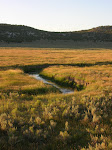
The official measure for the Stilly as of the time of this writing is 21 feet above flood stage. The photo here taken yesterday showed the water moving between 19 and 20 feet on the gauge. It's still raining here so the real crests won't come until this afternoon around four p.m. It is supposed to be getting cooler. That means instead of rain in the mountains and melting snow it will begin to snow again. That's either good news or delayed bad news - too soon to tell.

Seattle is cut off from all points south and east. The Chehalis River has overflowed I-5 in parts of a 20-mile stretch. The passes are closed over the Cascades to the east for fear of avalanches and mud slides. The Interbay area between Queen Anne and Magnolia, two Seattle communities, had a largish mudslide early in the a.m. More than a 50-foot swathe was reported to have crushed a carport and four bikes. No one was killed. Hard to imagine that even being news but Seattle people take their bikes very seriously. And really, mudslides around here can kill many people and change the topography in a very disturbing and personal way.

I'm posting a column I wrote way back in 1998 to the Walk the Lines, Tell the Tales sister blog. Looking at moving water in flooding rivers is a personally disturbing experience to me. A very graphic dream about my own death in a stream many years ago kept me from several river rafting trips. But it faded over time and I entered the waters again as a fly fisherman and canoeist. At least until the experience I report in the story, titled Sweepers.

Wednesday, January 7, 2009

Floods - Part of the Season

I am sandwiched by rivers. The Stilly on the north, the Snohomish on the south. Then Puget Sound via Possession Sound immediately to the west. These are large flow rivers draining their Cascade watersheds immediately to the east.

Winters are flood times here. Big floods happen when there has been a lot of snow (check), then warming with rain (check). This is true for most of western Washington with the difference being the relative increase in miles for the rivers to reach the ocean and the relative small difference in feet above sea level for the river's course. When a lot of snow melts and combines with a lot of rain, these rivers fill fast and just as quickly top their banks and fill their flood plains.

I took this picture just below the junction of the north and south forks of the Stillaguamish, what we call the Stilly. I'm looking north from Haller Park at the old and now unused railroad bridge that still spans the river here. The water is flowing from right to left, east to west. The water is moving between 19 and 20 feet. I just Flip-filmed a 100 foot tree, roots still attached, shooting past this point at a pretty good clip. It zipped through the railroad bridge abutments but hit the central abutment on the Highway 9 bridge sideways and backed up a huge wave for several minutes. Then another cut log with what looked like a two or three foot diameter swept down the current and rammed it on one side snapping it in two. The halves squirted on downstream.

Calculating the exact force that bridge abutment had to withstand would be an interesting exercise for an engineer and that would be exactly what the building specification would require. But think about it. Force is calculated by multiplying the surface area on the log (which changes as the water flows around its circular trunk and a drag factor also would have to be added) by the density of the water (water weighs about 2.2 pounds per liter) by the square of the water's velocity. I think that's pretty close to the right calculation, maybe another reader can add corrections, if needed. But the resulting force is then also transferred to the point of contact on that central pier.

In Path of the Paddle, Bill Mason says the force of an eight mph current on a canoe caught in a similar predicament can be two tons. I know from experience that you won't be moving that canoe against that current. The water flowing in the Stilly is traveling at what looks to be at least 20 mph, maybe faster.

Monday, January 5, 2009

Rivers Rising

Rivers will flood shortly. I looked for the anthology on rivers that Gary Holthaus contributed to, along with many others but have as yet not found it. One problem with owning a lot of books is figuring out where to put them all. This one must be either packed away or is hiding somewhere among the shelves. I recall it being over-sized, wider than it is tall, mimicking the landscape of looking at a river. Rivers are and will be a major theme of borders. That, I guess, is obvious.

Sunday, January 4, 2009

Taxes, Ha! Death Should Be Enough

Henry Miller spent a whole book talking about his connection to his parents. I don't remember right now whether it was in Nexus, which would make sense, or Plexus, both part of his self-obsessed multi-volume collection he labeled The Rosy Crucifixion, composed of seven titles all told. I read all of them a long time ago, what seems like at least two lifetimes and many border crossings ago. Not because I, like Miller, was obsessed with all things sex and self at the time, although I was, but because he was a writer who just seemed to let loose.

Execrable he was to decent folk - not a word or sentence structure that appears in most blogs. He was generally detested. Too wordy and rambling as a writer, too quick to make everything into an opportunity to fornicate or eat, too facile an imagination with his own history. His books were banned in the U.S. for straightforward lewdness up until just a couple of decades before last. What's not to like? Henry walked in many of those borderlands I have only imagined, certainly international in scope (he wrote and published mostly in Europe) if extremely local in topic. Libido, I would argue, is a local and very subjective map.

As it happens, the apex of my Miller reading occurred in the Four Corners borderland near Telluride, Colorado, in the late '70s. I think. I share a soft memory of timeline with Henry, but the town was still mostly a rundown former mining settlement just starting to be a ski town then. I just posted a story on the sister non-blog to this one you might enjoy. Or you might not, what the hell. It does touch on fornication though, if you're interested.

I've mostly moved away from fornication and Miller to death and Julian Barnes and Jules Renard. Fornication and death are sometimes compared with a small equal sign. I am not yet old enough to know why but I'm of an age to find the latter more interesting than the former. I've got a different take on Across the Borderline, the song written by Ry Cooder, John Hiatt and Jimmy Dickinson for a movie called The Border about Mexican drug trafficking. This is one of those songs that grows to mean much more. It expands to easily fit the proportions of a Roland Barthes 'Myth' with a capital M. It was sung right by Willie Nelson on the album of the same title. You just listen to Willie sing the first verse and the chorus and you have the death thing pretty well nailed. And the Rio Grande flows easily into the waters of Lethe.

Saturday, January 3, 2009

The Borders of Old Men


Old men have all kinds of borders. Since blog experts tell you that statistics and facts are valued by blog readers, I'll even tell you the number: 743. If you're really bored some time (well, you're reading this aren't you?) you can make a list. I don't have to make a list because I carry those 743 in the creases and wrinkles they have etched.

Besides, with old men the what and how many aren't as important as the developed adeptness at moving over and through those borders. When this year started I was going broke. One day later I was on my way to earning my next, albeit small, fortune. My finances haven't changed a lick, nor have my prospects. What has happened is that I have moved through the borderlands, examined the country, reassessed the lay of the land. Borders, when you carry your years right, aren't fences, they are mysteries. Everywhere and nowhere.

I have young women friends all over the world. My wife is okay with that. She likes that I talk with attractive, intelligent women like her. She says it improves my sense of humor and other areas that you don't need to know about. I like it also because it is a way to walk along a social border of monogamy in a mental world of polygamy.

Don't misunderstand me. I don't respond to Fey, who has a picture I can look at and wants to be a friend of mine on Skype. Not because Fey is by all counts really Dlohg from Pitesti but because as an old man I have no borders to cross in that direction. I block Fey/Dlohg. My women friends have been and are all people I want to talk with for hours about what they think and see and do.

Women are inherently more interesting to old men than other old men. I've taken a poll and fully 93 percent of the respondents said yes when asked that question. The other seven percent merely gibbered unintelligibly. But I hadn't yet taken my medication that prevents gibbering. That said, I admit that I did not ask any of my gay friends the question.

One of my women friends sent a concerned email when she read I was going broke and expressed relief that the next day I was back on track. She is living and traveling in Europe. Others sent concerns from Mexico and South America. Old men must be ready to move across many borders, sometimes in many directions at once.

All borders, it can be said, should be open to examination and exploration. I know that because I have, in fact, just said it. Old men who have put their time to good use know how to place their footsteps and make the journey worth taking. And wouldn't it be nice if they died trying?

Friday, January 2, 2009

Mind Border


There are all kinds of borders. I said that yesterday walking in the rain. It is still true today in spectacular sun and winter clouds. And what's funny is the same physical place can be a border for many things. Or maybe that's not so funny as much as obvious. The state I was in yesterday is not the state I am in today though; that I know.

I took the same walk on Grand Avenue that I took yesterday but the terrain was completely different. The grand houses clustering on the north end? Not real. Sure, there is the real-life mansion on the 300 block of Alverson, but Alverson isn't yet Grand Avenue. You don't really get to Grand Avenue until you get to Maulsby Lane. What you run into going south isn't those grand houses I imagined in the mist but a fairly typical mix of middle class houses. And yes, the prices are not what you could classify as middle class but neither is the view - when you can see it.

The photo above is from just about the same place as the one I posted yesterday. See, there is a carrier docked there at Everett Naval Station, the U.S.S. Lincoln. And when you finally reach the Grand Avenue Park across from the late Senator Henry M. "Scoop" Jackson's home it becomes just a rather large white house on the corner of a block with some other rather large houses. They're all nice older houses that you might associate with "old money" but not grand, and certainly not movie or sports star ostentatious. Not fifty bedroom mansions with double that in bathrooms. Maybe more like fifteen bedrooms.

Yesterday I was about to go broke. Today I'm on the edge of remaking my [very small] fortune.

Thursday, January 1, 2009

The Border of Money


There are all kinds of borders. I like to walk along what could be called a socioeconomic border in nearby Everett, WA. In about 15 minutes I can be on Grand Avenue. At the north end it has grand houses, towards the southern part of my walk the houses are working class. The street runs along the top of a bluff overlooking a part of Puget Sound called Port Gardner, which used to be pretty much a working port and waterfront. Now, not so much.

The biggest of the big houses are multistory and have views, although not today. It's raining and there is a heavy mist between my eyes and the yachts moored at Everett Marina and Everett Naval Station, where only a hint of our big carrier suggests itself. Hat Island seems to be there and Whidbey Island's coast appears and disappears. That view west is as gray as my thoughts.

A couple of hundred feet below at the bottom of the bluff are the train tracks used as a switching yard but the clanks and groan of humping rail cars are also muffled in the mist of January. The tracks hug the bottom of the bluff north under the big houses and run south to the paper mill that dominates the shoreline and the views of the raggedy houses where its workers once lived. They now house poor people from all walks of life.

A few of the relatively smaller north end houses are for sale: $695,900, price reduced. Of course the really big ones do not include prices or a plastic box stuffed with Xeroxed full color description sheets screwed to the For Sale post. They cost what they cost. Scoop Jackson's house is on Grand Avenue so, you know.

I like to walk on Grand Avenue. In the rain. In January. On the first day of the year I'll probably go broke. Which is another story and one that certainly isn't and won't be original.