Sunday, November 2, 2008

Searching for the Corner, Silence

Returning to Nevada, August 15, 2008...

The dust pulled up by the truck is killer stuff. I have to keep some speed up to stay ahead of the engulfing cloud which is a little tricky on a winding dirt road with no shoulders. I am now lost in the maze and have backtracked two or three times to see if I can't find a road that continues east and south. I am stubbornly staying away from using the GPS unit, which is a hand-held model. I want to see if using the topo alone will work. Besides, every time I have to stop to read the GPS or to get away from the truck so the compass won't be affected by the metal the dust settles - on me.

I finally reached a low ridge where the dust wasn't so bad. There was a round-up corral and uninterrupted views in all directions. I got out and took a water bottle and the digital camera. This is where I got the photo of the beef skeleton in the earlier post. I found a small outcrop and sat.

Often in places like this you expect it to be quiet and are surprised by the insect hum or other background environmental noise. I wasn't surprised to learn that you carry some noise with you - that after driving or riding a horse or running or walking it takes a few minutes for your inner ear and nervous system mechanisms to turn off. When that finally happens the low-range noise around you can crescendo in a startling way. So I waited. Nothing.

In Sedona, Arizona, there are people who believe the earth itself makes a noise, a sound you can hear, a vibration that you can even feel in moments like this. In Taos, New Mexico, it has become iconized as the Taos Hum and can be googled as such. Scientists have recently pinned vibrations to the north Pacific in winter and the Atlantic off Brazil in the summer on wave action in the two oceans.

I was hearing and feeling nothing. Then a very faint whistle of far off wind and more silence. Finally, as if some unseen hand was turning the terrestrial volume knob, the insect noise became discernible, then more wind sounds.

I have to check this out. I don't know if I caught a convergence zone in the waves of sound that canceled them out, or if it was a 40-second nap time for living things and the wind. It was a wonder.

Saturday, November 1, 2008

Dispensing with guilt

I just finished Andrew Sullivan's Why I Blog piece in the November Atlantic. And I watched his interview video called Your Brain on Blog that is attached to it. The guy is being driven by his blogging addiction. He says he gets a thousand emails a day. He says he can feel the collective breath of his audience waiting for his next every-20 minutes response. He said when he took some time to collect his thoughts his audience thought he was dead, fired, or muzzled.

That is nuts.

There was another Atlantic article in the July/August issue (yes, I do read other magazines and newspapers, and unlike Sarah Palin I can tell you the names). It was by Nicholas Carr and was called, Is Google Making Us Stupid? with a kicker above: What the Internet is doing to our brains. You may have seen it.

This whole project of mine is about telling stories, about combining new media with history, geography -- with trying to see what comes from walking in places not many people walk. Some of the writing needs and does try to employ journalistic standards - facts (such as they are) not opinions. Some doesn't and I've tried to label different approaches so as to not be misleading.

What happens here are pieces of a longer form. Maybe it will fall under a non-fiction heading. It may turn out to be more correctly labeled as creative non-fiction. Either of those are worth aspiring to. What it isn't is thoughts forced up from a mental stew every 20 minutes, cooked or not.

So if and when you visit here know that. You may want to actually look at some of the older posts, knowing how I'm working this. Or not. You might want to flit off somewhere with fresher roadkill.

Sunday, October 19, 2008

Research Paper Hiatus


Work on a research paper is causing a brief hiatus. Will continue posts in the near future. I feel a bit like a slacker because several of my classmates (whose blogs appear on my blogroll) seem able to both keep their blogs updated and do their schoolwork. I can't seem to. I'm struggling to push the development of a new communication model dealing with bias filters in encoding and decoding toward a final thesis and some phase of that, hopefully, toward a dissertation.

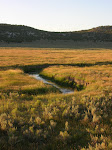
Walking the borderlines is a retreat into sanity for me. Writing about it the way I want to write about it here, involves more research. The NW corner area of Utah is open to a large sky and at the same time loaded down with history, dimensional history, that moves in all directions in time. Often what you see on the ground in the time you are walking looks sparse and skeletal as the bleached bones in the photo below. But if you carry with you the perception of past and possible future events there is a pervading sense, if not sight of the small photo above.

Tuesday, October 7, 2008

Searching for the Corner, Dust

August 15, 2008 - Friday

Driving south on Highway 93 from Twin Falls, Idaho toward Wells, Nevada is hot work in August. The air conditioning in my truck hasn’t worked since I bought it. You pay $3,000, you take some chances.

The map shows a maze of roads leading eventually to the northwest corner of Utah. Or the northeast corner of Nevada. Or the southern border of Idaho where it meets Utah and Nevada. Such tri-part borderlines on a map are mysterious, beckoning. On the ground, especially in the big emptiness of the west, such corners are marked only by an embedded pipe with USGS runes and maybe the butt post of a fence line.

The landscape is open, what movie cowboys might call wide open, and brown shades predominate. All of the shades of brown are washed with a hot chalky white. Even the fault-block battlements, purple in the distance, are striated by chalky veins. The sky, normally indigo or blue-black, is tan.

Turning left from the Highway onto Shoshone Basin Road the truck immediately pulled dust around itself. I stopped to check the GPS. I use a Garmin Colorado handheld and it takes its time coming on, then I have to fiddle with the screen lighting if it’s daylight to see what’s there. I get a fix on my position and orient the topo. Between me and the border is a lot of grazing land. All the dirt roads go to new graze, most to scattered water troughs where the water is hauled in, but the roads are also used by semi’s pulling filled livestock trailers. The roads are rock and gravel based to support the weight in rare rainy weather and to give some permanence to these minor transport arteries. But dust blows in from topside and works its way up from the underbelly. There won’t be a way to avoid it.

Thursday, September 25, 2008

Phosphate Mining in SE Idaho Borderlands Targeted

U.S. Water News reports a legal battle shaping up between environmentalist groups and the J.R. Simplot Company over the company's phosphate mining operations in a southeastern Idaho wilderness area just 10 miles from the Wyoming border.

An Earthjustice attorney, one member group of the environmental coalition, said an expansion plan granted by the U.S. Forest Service "is going to turn substantial acreage of roadless land into an open pit phosphate mine." Only the head administrators of the Forest Service, BLM and Interior Secretary Dirk Kempthorne are named as defendants, but the suit is aimed at expanded mining by J.R. Simplot, which operated other phosphate mines along the border of the Greater Yellowstone Ecosystem where all 17 are designated under Superfund status as environmental threats.

The specific site in question is the Smoky Canyon area in the Webster Range at approximately N 42 degrees 44' lat. and W 110 degrees 58' long.

Tuesday, September 23, 2008

Check out "Sheep Bitch"

There is a new Tall Tails, Damn Lies posting on the fiction sister blog to Borderlands Traverse. I have been promising this story for quite awhile now so I'm understandably cheery about finally getting it written, rewritten and posted. Please take a look and see what you think. Just click on WALK THE LINES, TELL THE STORIES in the Main Links list below right. Warning: the language, as you might guess from the title, has not been sanitized.

Wednesday, September 10, 2008

Storytelling Along the Way

I just ran across a fascinating reference in Nathaniel Philbrick's Mayflower (2006, Viking, New York, p. 105). Philbrick says on one of their first trips inland from the Plymouth settlement in July of 1621, the Pilgrims ran across a group of local Indians who had been gathering lobsters in the harbor. The natives explained the circular, foot-deep holes that could be seen all along the trail they were following.

The holes commemorated "any remarkable act" and it was the duty of person's traveling the path to keep them in repair and further to tell others what had happened there with the hoped for result that "many things of great antiquity are fresh in memory."

Philbrick goes on to quote (italics) from Edward Winslow's account of Plymouth Settlement about what he felt were the reasons for this. He notes that he and hyis companion on the inland journey, Stephen Hopkins, "began to see that they were traversing a mythic land, where a sense of community extended far into the distant past. 'So that as a man travelleth...his journey will be less tedious, by reason of the many historical discourses [that] will be related unto him.'"
"